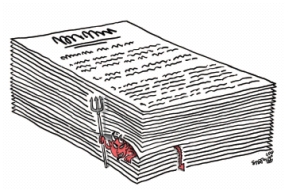
The Devil is in the details

How much detail to put in your novel?
What a pain in the arse that one is!
I remember in school, teachers ranting and raving about detail being king. If your story/essay wasn’t crammed full of insignificant details then you didn’t know how to write properly. Especially in the dreaded ‘what I did this summer’ essays that most children are forced to write at some point in their life.
ME: This summer I was abducted from my bed by aliens
TEACHER: What colour was the duvet cover? Details, Steven. They’re extremely important.
Now while this may be true to some degree, it’s a little hard to get interested in irrelevant details. My teachers always insisted that nothing was extraneous and that writing should be chocked full of, what I deemed useless; facts, finer points and particulars. Bollocks!
Detail should be used very carefully, such as describing something that can be misinterpreted. By filling in the details that can be misconstrued the story can be communicated clearly and effectively. You don’t need to detail every minor feature of a character or every tiny part of a building.
Listing the Latin names for every flower the MC passes; the architectural style of each building they enter; and the tiniest expression/gesture they perform. Although I’m sure this will impress some people it is not necessary.
Detail can also mess with the readers mind. For example I was halfway through the first chapter of a new book the other when a detail crept up and gave me a swift punch in the stomach. The MC was driving through the country, reminiscing about how they were there last winter and was so much happier coming here during the summer. They were admiring the plants and the grass and the sky (I know details, details, details), and after several pages the extra detail struck without warning. Apparently it was night time. Say what?! It was mid afternoon, blazing sun a minute ago. Of course it wasn’t, the author never established what time of day it was, but after all the description of beautiful summer flowers, and how much nicer it was there in the summer it came as a bit of a shock.
Readers will always fill in the details that aren’t mentioned, and slipping information in last minute can really screw with their minds. What makes it worse is when authors ‘trick’ their readers with details only to reveal that the reader was wrong all along, and isn’t the author clever for fooling you.
No.
It’s not big and it’s not clever.
Adding too many details can also get a writer in trouble. If the MCs cousin suddenly changes gender, then it might not upset the balance of the story too much but it might just bring the reader out of the story enough to make them realise it IS a story. That’s not what we want as writers. We need to pull readers in so they really believe the story, and if they get wrapped up in the plot then details suddenly aren’t the most important thing in the world.
The beauty of a book is in using your imagination, and too much detail can prevent this. If the reader gets involved with the characters, follows their story from chapter to chapter only to find a description of them that contradicts everything in their head, they might be a little hurt. Feel a little cheated. Like I said before, this only applies if you suddenly change the game, add pointless details too late in the story.
Like a good joke, you have to add the details as soon as possible and as soon as they are relevant. None of this “Oh did I forget to mention the guy had a duck under his arm?” It spoils the fun of the joke/story.
So take care with the finer details, use they wisely (and liberally) and try to get the reader so involved with the story that they believe it and it comes to life in THEIR head. You don’t need to play into the devils hands with too many details.
A brilliant post, Steven. If there is one thing that annoys me more than any other, it's over description. I'm not saying I don't do it myself but I try hard not to!
I find some writers indulge in this to the detriment of the storyline – Lee Child is one! Don't get me wrong, I love the Reacher novels – but sometimes I'm shouting "OK I think I understand about the intricacies of projectile definition, combustion differentials and climate disparity – JUST GET ON WITH THE STORY!!!"
Absolutely.
Hi Steven. Great post. Over description! It can kill off finishing a story/novel for me. As you said, just a liberal sprinkiling is enough. It's the same with dialogue. The majority of the time "he/she said" is enough. By what they have said or what they were doing before or while the said it tells us that they "gasped" or "spat" or "whatever other word writers use to make them look like they know lots of big words". Simple and precise is enough, well for me it is!
Nice one! You have a new follower!
Have a great weekend, my friend!
I agree too many details can spoil it for the reader. Give a small pointer about the scenery or your character's outfit and we'll imagine the rest.
That's why books turned into films are always disappointing – they never match the picture you had in your head when reading the book.
I completely agree with that post. Novels are a conversation and a lot of writers forget that. If we constantly shout over the top of the reader they never have a chance to have their say. Leave gaps so the can be filled.
The funny thing is it also leads to a strange phenomenon when the book is adapted for the screen. Some viewers will walk away from the cinema complaining how the protagonist was all wrong, the baddie wasn't as evil or have that strange looking face like in the novel, or the locations were totally different. Then we go back and realise none of these things were actually in the book. They were in our own little movie we created in our mind when we were reading.
When we leave gaps we leave space for the reader to make the novel cinematic in their own minds while they read.